
Imagine two people starting an online business.
The first has 10,000 social media followers. Their posts get hundreds of likes, their videos occasionally go viral, and their profile looks impressive enough to make a marketing agency jealous.
The second has just 100 customers. No viral videos. No impressive follower count. No strangers commenting with fire emojis.
But those 100 customers know the business, appreciate what it offers, and keep coming back.
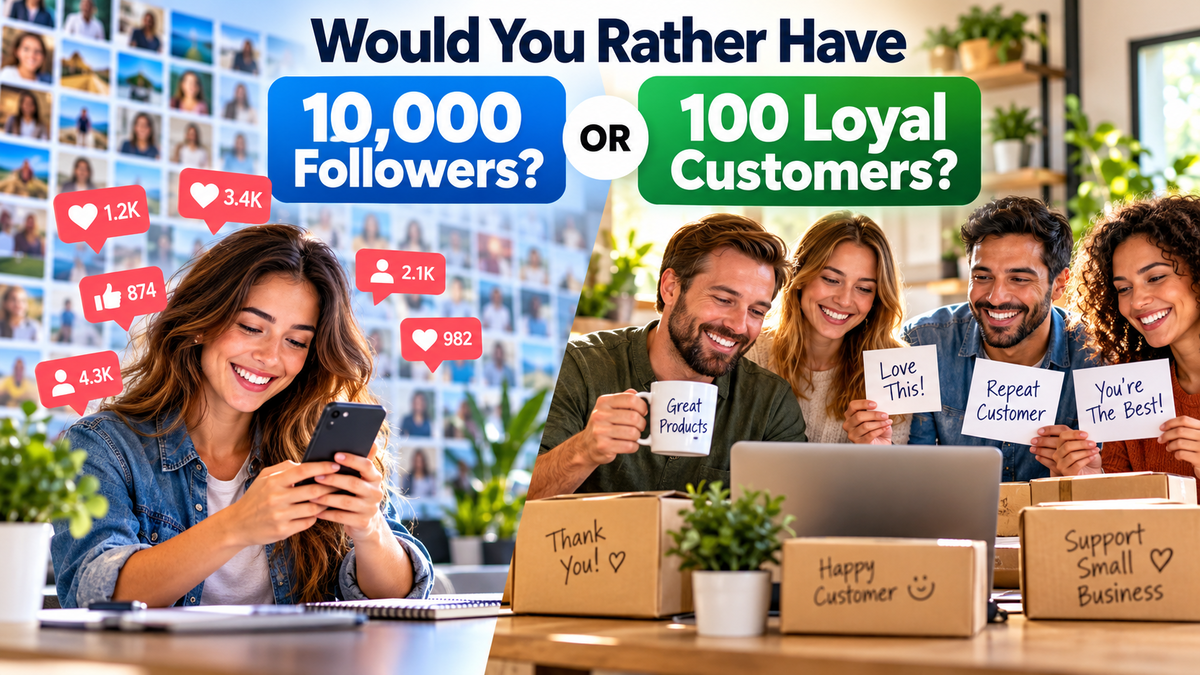
Now here’s the interesting question: Which person would you rather be?
At first glance, 10,000 followers sounds like the obvious winner. That’s a lot of potential customers, a lot of visibility, and a lot of people who might eventually buy something.
But the more you understand how online businesses actually make money, the more interesting this comparison becomes.
Because attention and trust are two very different things.
The Seductive Power of Big Numbers
There’s something irresistible about watching a follower count climb.
One hundred followers becomes 500. Five hundred becomes 1,000. Before long, you’re dreaming about hitting 10,000, then 50,000, then that magical six-figure milestone.
And there’s nothing inherently wrong with that.
A large audience can create tremendous opportunities. It can introduce your business to new people, attract partnerships, generate referrals, and provide a steady stream of potential customers.
The problem begins when we confuse having an audience with having a business.
Think about the last time you scrolled through social media.
How many posts did you like? How many accounts did you follow? How many videos entertained you for a few seconds before you moved on?
Now ask yourself how many of those interactions resulted in you purchasing something.
Probably not many.
That’s not because those creators are doing anything wrong. It’s because following someone requires almost no commitment. Buying from someone requires considerably more.
A follower might enjoy your content.
A customer has decided that what you offer is worth their money.
That’s a meaningful difference.
Let’s Do Some Surprisingly Simple Math
Suppose you have 100 loyal customers who each spend $50 with your business four times a year.
That’s:
100 customers × $50 × 4 purchases = $20,000 in annual revenue.
Now imagine someone with 10,000 followers who manages to turn 1% of that audience into customers making a single $50 purchase.
That’s:
10,000 followers × 1% × $50 = $5,000 in revenue.
Of course, these are hypothetical examples. Actual results depend on the product, profit margins, customer behavior, and countless other factors.
And the business with 10,000 followers could absolutely outperform the smaller one.
But that’s precisely the point.
Follower counts alone tell you almost nothing about the financial health of a business.
What matters is what people actually do after discovering you.
Do they visit your website? Subscribe to your emails? Ask questions? Make purchases? Recommend you to friends? Come back six months later?
Those behaviors reveal something a follower count never can.
The Customer Who Comes Back Is Worth More Than You Think
There’s an old business principle that acquiring a new customer often costs more than retaining an existing one.
The exact economics vary by industry, but the underlying lesson is worth remembering.
Winning someone’s trust for the first time can be difficult.
You have to introduce yourself, explain what you offer, overcome skepticism, answer questions, and give someone enough confidence to take a chance on you.
But once you’ve delivered a genuinely good experience, something changes.
That customer no longer has to wonder whether you’re legitimate.
They already know.
If they need something similar again, your business may be the first place they look.
And when a friend asks for a recommendation, your name might be the one they remember.
One satisfied customer can become a repeat buyer, a source of referrals, and an enthusiastic supporter of your business.
Not because you’ve mastered some clever marketing trick.
Because you did what you promised.
It’s amazing how powerful that can be.
Your Email List Might Be More Valuable Than Your Social Following
Here’s another question worth considering.
Would you rather have 5,000 Instagram followers or 500 people who voluntarily subscribed to your email newsletter because they genuinely want to hear from you?
There’s no universal answer, but I’d pay very close attention to those 500 subscribers.
Why?
Because social media platforms decide how widely your content gets distributed.
You can have thousands of followers and still reach only a fraction of them with any particular post.
Algorithms change. Features disappear. Accounts get restricted. People gradually stop seeing your updates.
An email list gives you a more direct way to maintain relationships.
You still depend on email providers and good deliverability practices, of course. And an email address isn’t permission to bombard someone with promotions.
But when someone willingly invites you into their inbox, that’s an opportunity to build a relationship that doesn’t depend entirely on a social media feed.
The key is treating that invitation with respect.
Send useful ideas. Share interesting discoveries. Answer common questions. Occasionally recommend something genuinely worthwhile.
Give subscribers reasons to look forward to hearing from you.
A small email list filled with interested, engaged people can be far more useful than a massive list of people who barely remember subscribing.
And that brings us to one of the most overlooked ideas in online marketing.
Engagement Isn’t About Getting More Reactions
Imagine posting a business tip and receiving 500 likes.
Feels pretty good, doesn’t it?
Now imagine posting that same tip and receiving only 12 likes, but three people ask thoughtful questions, two subscribe to your newsletter, and one becomes a paying customer.
Which post was more successful?
It depends on your goal.
If you’re trying to build brand awareness, those 500 likes might have real value.
But if you’re trying to build a sustainable business, the second post may have accomplished considerably more.
This is why engagement deserves a broader definition than likes, shares, and comments.
Meaningful engagement can include someone reading an entire article, replying to an email, returning to your website, requesting more information, or recommending your content to another person.
Sometimes the most valuable member of your audience is someone who never comments publicly.
They simply read what you publish, trust your judgment, and eventually decide to do business with you.
You might not even know they’re paying attention until that day arrives.
The Mistake Small Online Businesses Make
Many entrepreneurs approach marketing as if their only job is to attract more people.
More traffic.
More followers.
More subscribers.
More leads.
And yes, attracting new people matters. Every business needs a way for potential customers to discover it.
But imagine owning a little neighborhood coffee shop.
Every morning, you stand outside handing out flyers to attract new customers.
Meanwhile, the regulars who already love your coffee walk in, receive indifferent service, and gradually stop coming back.
Would your solution be to print more flyers?
Probably not.
Yet that’s essentially what happens when online businesses focus exclusively on attracting new visitors while neglecting the people who have already shown interest.
Someone subscribes to a newsletter and never receives anything particularly helpful.
Someone buys a product and never hears from the business again.
Someone asks a question and waits days for an answer.
These are missed opportunities to build relationships that could last for years.
Sometimes the smartest marketing move isn’t finding another thousand strangers.
It’s taking better care of the hundred people who already know you.
Five Ways to Build a More Loyal Audience
You don’t need a complicated marketing system to start building stronger relationships. A few thoughtful habits can make a meaningful difference.
1. Be useful before asking for anything.
Publish information that helps people solve real problems. Teach something practical. Share a resource. Explain a confusing topic in plain English.
When people repeatedly benefit from your content, they begin associating your name with value.
2. Give people a reason to stay connected.
Invite website visitors to subscribe to your email list, but make the invitation worthwhile.
Instead of simply saying “Join my newsletter,” explain what they’ll receive and why it matters.
Then deliver on that promise.
3. Pay attention to questions.
Questions reveal what your audience actually needs.
If three people ask about the same challenge, that’s probably a subject worth addressing in an article, email, or video.
Your audience can become one of your best sources of content ideas.
4. Recommend carefully.
This is especially important in affiliate marketing.
Every product you recommend affects your credibility.
A quick commission from a disappointing product might generate a little revenue today while costing you a valuable relationship tomorrow.
Think beyond the immediate sale.
5. Remember the people who already bought.
Follow up when appropriate. Provide helpful instructions. Share updates. Make support easy to find.
And when you have another relevant product or service, your existing customers may be the people most interested in hearing about it.
Loyalty grows when people feel appreciated rather than constantly sold to.
The Best Businesses Don’t Actually Have to Choose
There’s a twist to our original question.
Having 10,000 followers and having 100 loyal customers aren’t mutually exclusive.
In fact, they can complement each other beautifully.
A large audience can help you reach new people.
An engaged email list can help you develop relationships with those people.
A trustworthy business can turn some of those relationships into customers.
And excellent customer experiences can encourage repeat purchases and referrals.
That’s a healthy progression.
The trouble starts when we focus so heavily on the first step that we forget everything that comes afterward.
It’s tempting to measure success using the numbers everyone can see.
Followers. Views. Likes. Shares.
But the numbers that often matter most are less glamorous.
How many people return?
How many people trust your recommendations?
How many customers buy again?
How many would genuinely miss your business if it disappeared tomorrow?
Those are harder questions to answer, but they’re worth asking.
So, Which Would You Choose?
If someone offered me 10,000 random followers or 100 genuinely loyal customers, I’d choose the customers.
Not because followers are worthless. Far from it.
I’d choose the customers because they’ve already demonstrated something that can’t be manufactured with a clever headline or an entertaining video.
Trust.
And trust is one of the most valuable assets any business can develop.
The encouraging part is that you don’t need a massive audience to begin building it.
You can start with one helpful article, one thoughtful email, one honest recommendation, or one customer who walks away feeling genuinely glad they found you.
Do that consistently, and you may eventually build an audience of thousands.
But even if you never become internet famous, you can still create a business that matters to the people it serves.
Because 10,000 people knowing your name is impressive. Having 100 people who trust it might be even better.

Debbie Evans shares practical tips, tools, and resources to help make building income online simpler and more approachable. Through this website, Debbie provides helpful content and recommendations, including the Plug-In Profit Site, a system designed to help beginners get started online with a website, step-by-step training, and built-in income streams. Learn more about getting started with Plug-In Profit Site here.